A hernia is a common condition
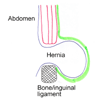
that can affect people of all ages. It is caused
by a weakness in the abdominal wall, and when
the patient coughs or strains a lump may appear.
Patients often present with a small reducible
lump in the groin, which can be tender. Surgery
under regional, local or general anaesthesia is
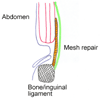
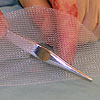
usually straightforward. A plastic mesh is often
used to strengthen the repair. This open lattice
work of plastic is rapidly incorporated into the
tissues increasing the strength of the repair.
Return to normal activities is usually rapid.
It is usual to
advise repairing the hernia before it strangulates
or becomes irreducible.
Laparoscopic hernia
repair
In the past most hernia
were repaired using an ‘open’ approach; a 5-8cm
cut is made in the groin and a mesh repair
completed. An alternative approach is to perform
a laparoscopic hernia repair. This involves
three very small cuts (1 x 1 cm and 2 x 5mm)
around the level of the umbilicus (tummy
button). The operation is performed from the
inside of the abdomen (tummy cavity). The hernia
is confirmed and the sac reduced. A mesh is then
tacked over the hernial orifice, so repairing
the hernia from the inside. The laparoscopic
approach has the advantage of a faster return to
normal activities and is particularly good for
bilateral (both sides) hernias and recurrent
hernias. The disadvantage is the patient has to
be put to sleep and the recurrence rate may be
slightly higher than the conventional open
approach in some situations.
A sportsmans hernia is
an important alternative cause of pain in the
groin in active individuals. There is a potential
weakness in the abdominal wall where a hernia
would normally appear. The area affected is tender
but a lump is not usually felt. Surgical repair
usually gives excellent relief from the symptoms
and return to normal sporting activities is fast.
Laparoscopic Cholecystectomy
The gallbladder lies just
under the liver and normally collects bile. When
food is eaten (particularly fatty foods) the gall
bladder contracts. When the gallbladder contains
stones this contraction can be painful. Occasionally
the gallbladder gets infected (cholecystitis)
and this also causes pain. The gallstones are
usually diagnosed by ultrasound examination.
Gallstones can cause symptoms
that are sufficiently bad for the patient to want
to consider a surgical procedure to remove the
gall bladder. This is usually performed with telescopes
(laparoscopically), and can often be done either
as a day case or with an overnight stay. Four access
ports (2 X 10mm and 2 X 5mm) are used to insert
the instruments. The gall bladder, the cystic
duct and the cystic artery are carefully identified.
The artery and duct is clamped with metal clips
and then cut. The gallbladder is removed usually
using a ‘retrieval bag’. A drain may
be used. Return to normal activities is rapid.
Click
on image to enlarge
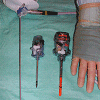
Laparoscopic
Equipment
Open and Laparoscopic
Splenectomy
Occasionally it is necessary
to remove an abnormal spleen in a patient with a haematological condition. Sometimes a laparoscopic approach
is possible.