Peripheral
Vascular Disease and Intermittent Claudication
Peripheral vascular disease affects a significant
number of patients and ranges in severity from asymptomatic
disease that does not affect the individual through
mild to moderate disease that interferes with lifestyle
through to severe disease that can result in pain
at rest or tissue loss.
This entire broad spectrum of disease requires ‘maximal
medical therapy’ to address all the risk factors
such as smoking, high cholesterol, high blood pressure,
diabetes and anti-platelet medication.
Milder forms of intermittent claudication are usually
best treated with an exercise programme. The aim
of this is both to improve the collateral or alternative
blood supply to the leg(s) and also to improve the
patient’s overall cardio-respiratory fitness.
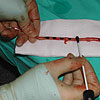
More severe forms may require and endovascular approach.
A wire can be passed through the narrow arteries
and a balloon used to open up the vessel (Angioplasty).
Click
on image to enlarge
Trends
in Vascular Surgery
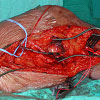
In the most severe cases some form of surgical bypass
may need to be considered.
Click
on image to enlarge
The Diabetic Foot
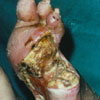
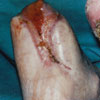
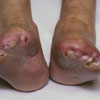
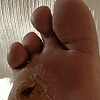
The diabetic patient is particularly vulnerable
to problems with circulation. In addition to having
problems with the circulation, they can also have
difficulty with sensation. A numb foot is at risk
of damage and great care must be taken to prevent
this.
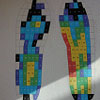
We have a particular interest in the 'at risk' foot,
running a Vascular Orthology Clinic at UCHW. This
is a multi disciplinary clinic with a consultant
vascular surgeon, a consultant in rehabilitation
medicine, an orthotist and a consultant tissue viability
nurse.
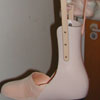
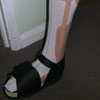
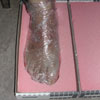
Bespoke footwear plays an important part in the
treatments offered, however the use of the patella
bearing orthosis or PTBO is the most common approach.
This technique was developed by the the multi-disciplinary
team, and invloves unloading the foot via the patella
tendon. This increases the speed of wound healing.
Patellar tendon bearing orthosis- application as
adjunctive treatment in healing lower limb tissue
loss. European Journal of Vascular and Endovascular
Surgery 1998; 16: 485-488
Charcots Foot
This is a complex problem associated with neuropathic
feet. The C&W CVU Vascular Orthology clinic
specialises in dealing with these difficult conditions.
A patella tendon bearing orthosis allows normal
mobility to be maintained.
Revisional Amputation
Surgery
With a unique multidisciplinary approach including
a Regional rehabilitation consultant, we are in
position to offer a service that includes review
of problematic existing amputations and occasionally
we will consider revisional amputation surgery.